Assoukrou Aké
A conversation with Assoukrou Aké on art history & archeology, transposition of European imagery for African storytelling, and CVD.
Rejoice Anodo
Chief Editor
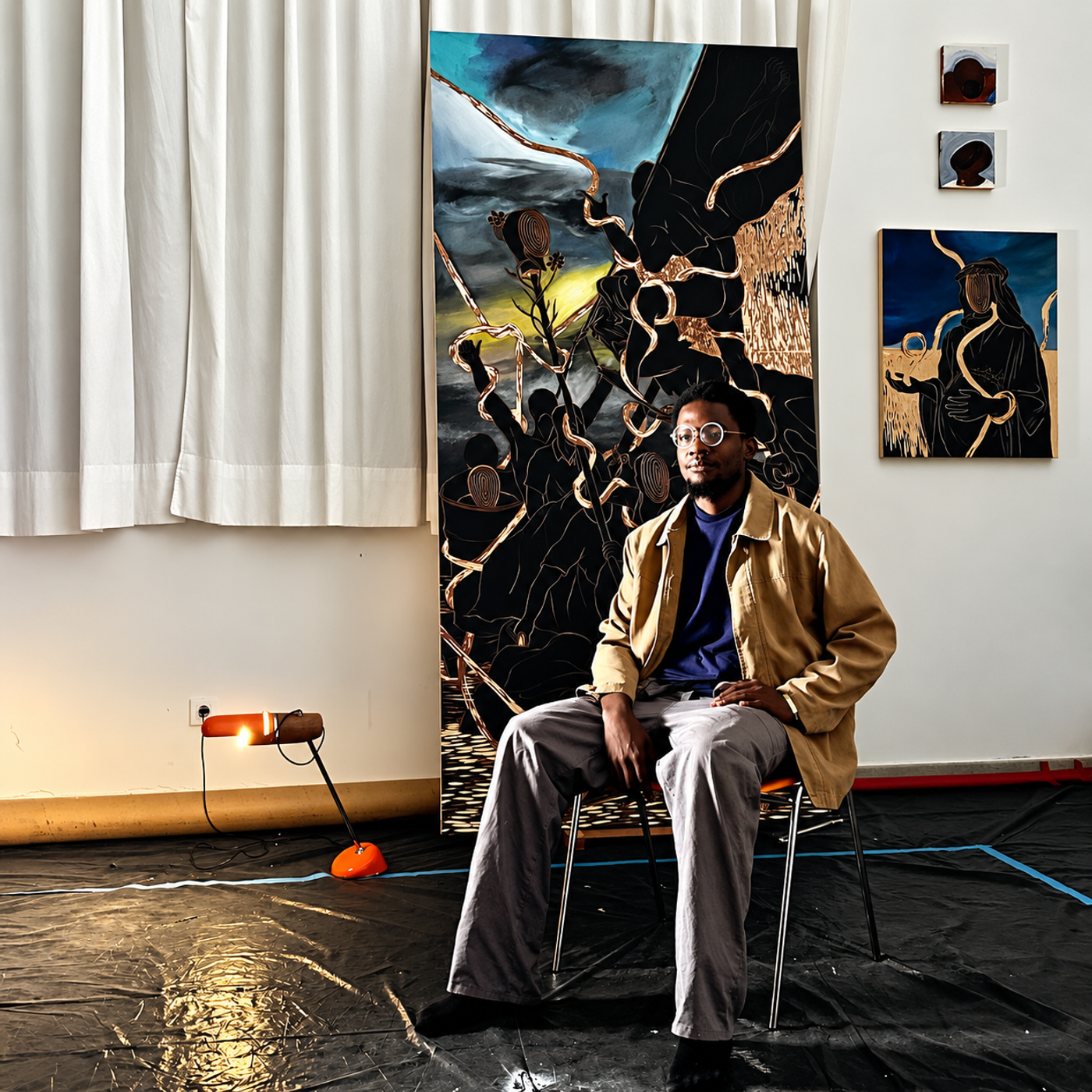
Assoukrou Aké, a Bonouan-born artist from the Sud-Comoé region in Ivory Coast, currently lives and works in Paris, France. He graduated with honors from École Supérieure d’Art et de Design de Tours in 2021 and won the Ellipse Prize for contemporary Ivorian art in 2022. He participated in several residencies hosted by Casa de Velázquez, the Joan Miró Foundation in Mallorca, the Josef and Anni Albers Foundation, and Yishu 8.
Here, he talks about his experiences in different cities as a multidisciplinary artist. Through Bonoua, Madrid, Mallorca, Senegal, Beijing, Abidjan, and Paris, different art mediums, CVD, and an educational background in art history and archeology all provide substance for his craft.
Rejoice Anodo: You were born in Bonoua and later moved to France, where you studied Art History at Nanterre, with Archaeology as an elective, before attending the École Supérieure d’Art et de Design in Tours. Why did you choose an academic route through art history first rather than going directly into studio practice?
Assoukrou Aké: From high school onwards, I already had a strong interest in history, art history, geography, and more broadly in the social sciences and anthropology. So studying art history, with archaeology as an elective, felt like a very natural direction for me. I was particularly drawn to archaeology because of this idea of excavation, research, and bringing traces of the past back to the surface. There was something fascinating to me about uncovering memories, studying them, and putting them back into circulation in the present. At that point, I really wanted to learn and explore these questions in depth before fully committing myself to an artistic practice.
RA: You now divide your time between Abidjan, Paris, and different residencies in France and internationally. How does moving between these different contexts shape your perspective and your work?
AA: What interests me about moving from one place to another is not simply the change of location, but the possibility of approaching each territory as a field of investigation. My background in art history and archaeology probably gave me that instinct: whenever I arrive somewhere new, I first try to understand what happened there, what remains visible, and what has disappeared. I spend a lot of time looking through archives, second-hand markets, antiquarian bookshops, and book fairs. The work often begins through unexpected connections: an image or document found in one country can enter into dialogue with a story encountered somewhere else or even with questions I have carried with me for a long time. This movement between places, periods, and narratives feeds a large part of my practice.
RA: Your path runs through an artistic baccalaureate, Art History studies, formal art school, and then a series of prizes and residencies. Looking back, which of those stages transformed your practice the most?
AA: I would say my residency at the Casa de Velázquez in Madrid. That year gave me something I had never really had before: time, distance, and an environment entirely dedicated to research and creation. I was able to slow down, explore certain questions more deeply but also step back and look differently at what I had already produced. Spending an entire year alongside other artists, researchers, and different disciplines also shifted the way I thought about my work. I think that was the moment when my practice became broader and more structured, and when I began to consider each project as a genuine field of research.
RA: You work across installation, sculpture, engraving, and textile. How do you decide which medium a particular idea or story needs?
AA: The subject often calls for one material rather than another. Some materials carry a certain resistance, fragility, or complexity that opens up more possibilities and allows several ideas to coexist at once. What interests me is precisely the moment when the material stops simply illustrating the subject and begins to produce meaning in its own right.
RA: You have spoken about placing yourself in the role of a “medical researcher” or storyteller conducting narratives of “healing.” What does that process actually look like in the studio?
AA: It often begins with archival research, followed by an almost anatomical process: dissecting, digging, cutting, revealing layers and bringing fragments to the surface. Then comes a gesture of repair, of stitching things back together and reconnecting separate elements. I use a lot of medical vocabulary in my work, particularly through thread, which can symbolically evoke surgical thread or a suture. There is also the figure of the storyteller. I often think about the stories we hear as children, their moral dimension, but especially what they conceal beneath their apparent simplicity. In my work, these narratives are displaced, transformed, and reintroduced in another form. Healing, then, is not simply about repairing something. It is also a way of reopening a story, examining its wounds, and trying to give it a new form.
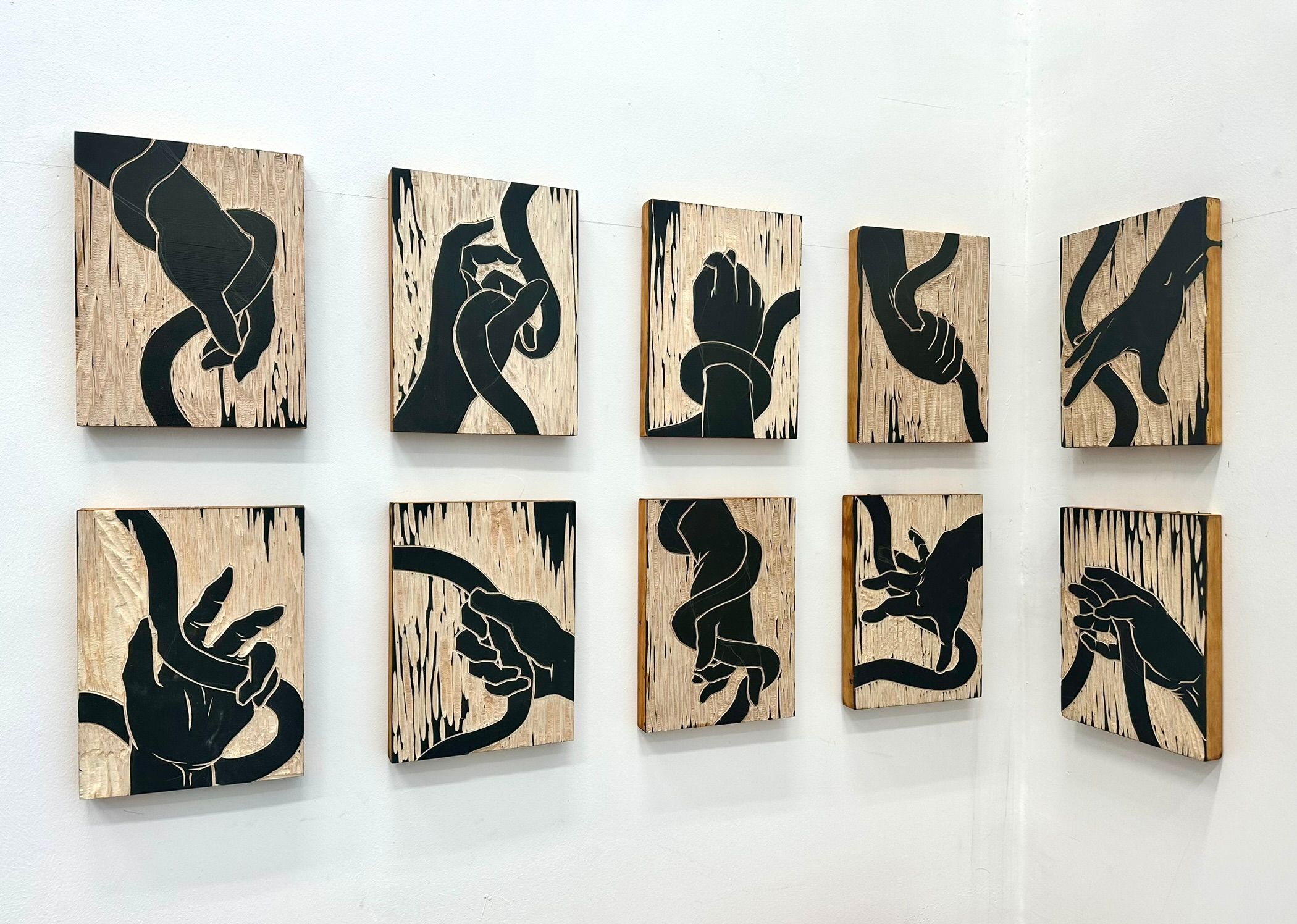
RA: The anonymous human figure with the spiral-like face recurs throughout your work. What does that figure represent to you, and why do you keep it without an identifiable face?
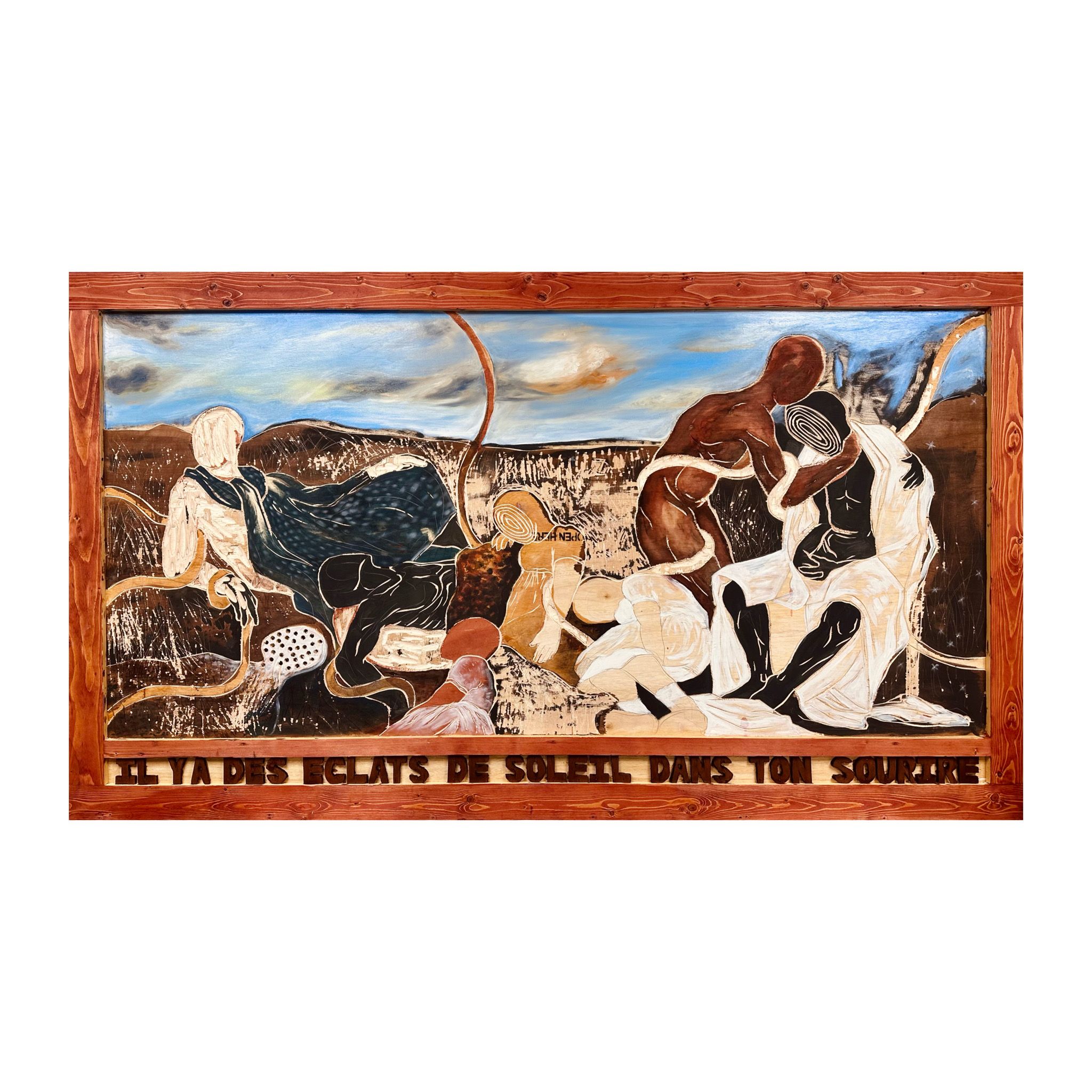
AA: The face is not actually a spiral. It comes from my reinterpretation of the Adinkrahene, an Adinkra symbol associated with authority and power in Akan culture. I use it to question what power produces within individuals and upon bodies, but also what can result from it: physical, social, systemic or symbolic violence. Keeping these figures without identifiable faces also prevents them from being associated with one particular community. I am more interested in opening the question of power onto something universal: the way it moves through societies, acts upon bodies, and can affect anyone, although in very different ways.
RA: You mentioned on Instagram that you are color-blind. Can you tell us more about that, and when you realized it affected the way you see your own work?
AA: I discovered it quite late, after I arrived in France in 2015, following medical examinations. For a long time, I resisted that particular aspect of myself before gradually understanding that it was also part of the way I see and that it could have a place within my work. Today, I try to integrate it much more consciously into my practice. That comes through in the way I approach color, but also through the juxtaposition of layers, signs, and materials. I work extensively from references to classical, academic, and Renaissance painting, which I bring into conversation with engraving, wood, silicone, and other raw materials. Together, they form a chromatic and material vocabulary of my own. Color blindness is no longer something I try to work around; it is something I accept and increasingly try to merge with my visual language.
RA: Your 2024 exhibition at Galerie Cécile Fakhoury, Les graines de semence ne doivent pas être moulues, engaged directly with Käthe Kollwitz’s work and words. What was it about her practice and history that resonated with your own?
AA: What touches me first in Käthe Kollwitz’s work is the way she understood pain and gave it a form. After the death of her son Peter during the First World War, her work became deeply marked by mourning, loss, and the violence of war. In her War series, she rarely depicts the battlefield itself. She is much more interested in what violence leaves behind: mothers, widows, children, bodies carrying absence.
That is precisely where I recognize something that resonates with my own work: this ability to take pain beyond individual experience and give it a more universal dimension. Her bodies are often bent, compressed, almost overwhelmed by what they are going through, yet engraving transforms that suffering into an incredibly powerful and sometimes almost spiritual image. What interests me is this possibility that art does not erase the wound but gives it another form, to the point where something poetic can emerge from it.
The title of my exhibition also comes from one of her final works, Saatfrüchte sollen nicht vermahlen werden "Les graines de semence ne doivent pas être moulues" (Seeds for planting must not be ground) made in 1941. Kollwitz regarded this phrase, borrowed from Goethe, almost as a testament against war and the sacrifice of younger generations.
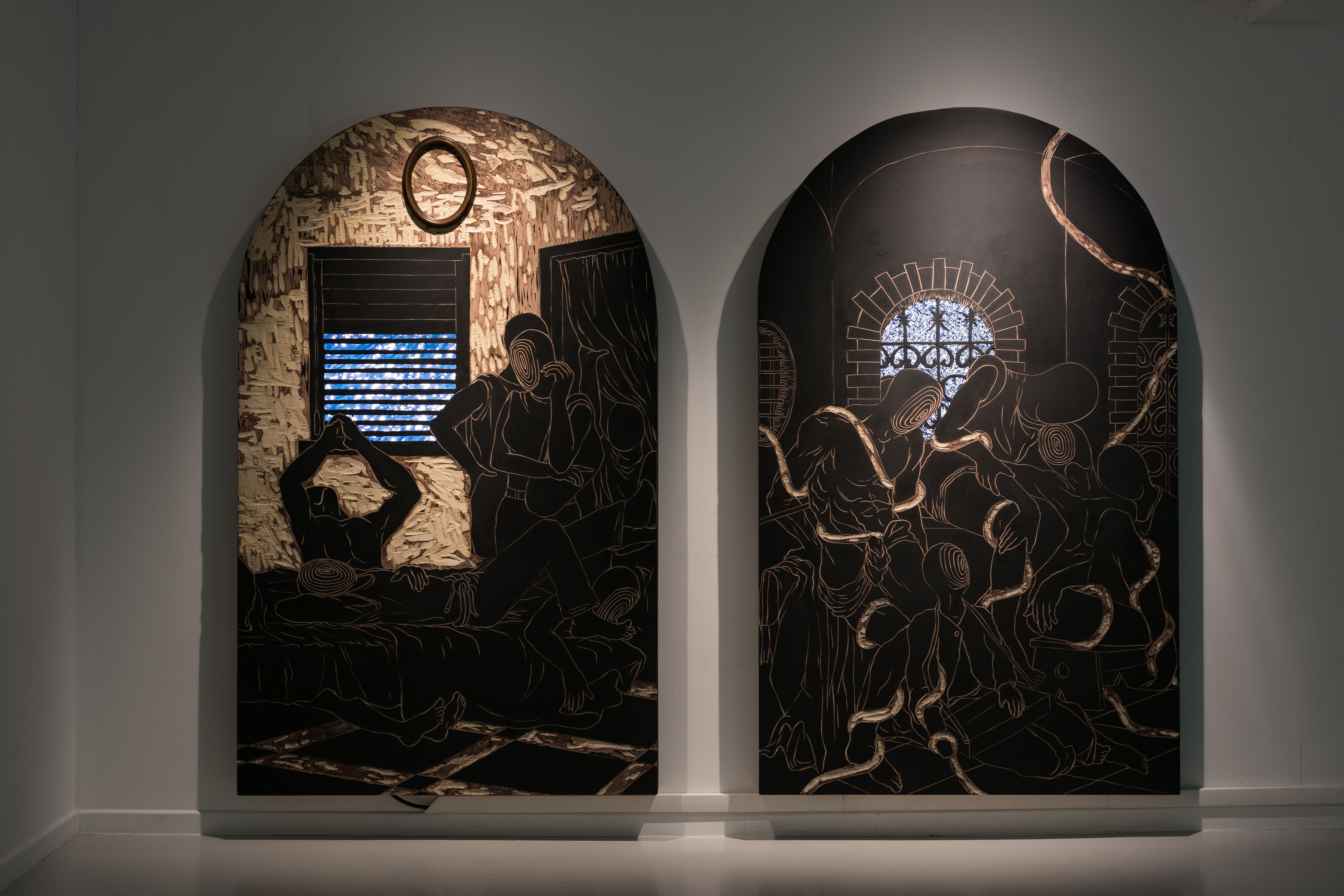
RA: Your work brings together African mythologies, enlightenment iconography, sacred allegory, classical European literature, and press photography. How do you keep all these references in conversation without allowing one to dominate the others?
AA: I start from all these different sources, but I almost never use them in their entirety. I fragment them and retain specific details: a figure, a gesture, a symbol, an image, sometimes a few words taken from a text. These fragments, whether they come from mythology, allegory, literature, or archival photography, then become elements within a new composition.
I often construct these compositions using the structure of large classical paintings, with one central element around which others gravitate. This allows me to bring together references that are very distant from one another in time or origin without trying to privilege one over another. They gradually form a kind of allegorical symbiosis. Ultimately, I am less interested in where each reference comes from than in what their encounter can reveal about tragedy, memory, disaster, but also the poetry that can emerge from those situations.
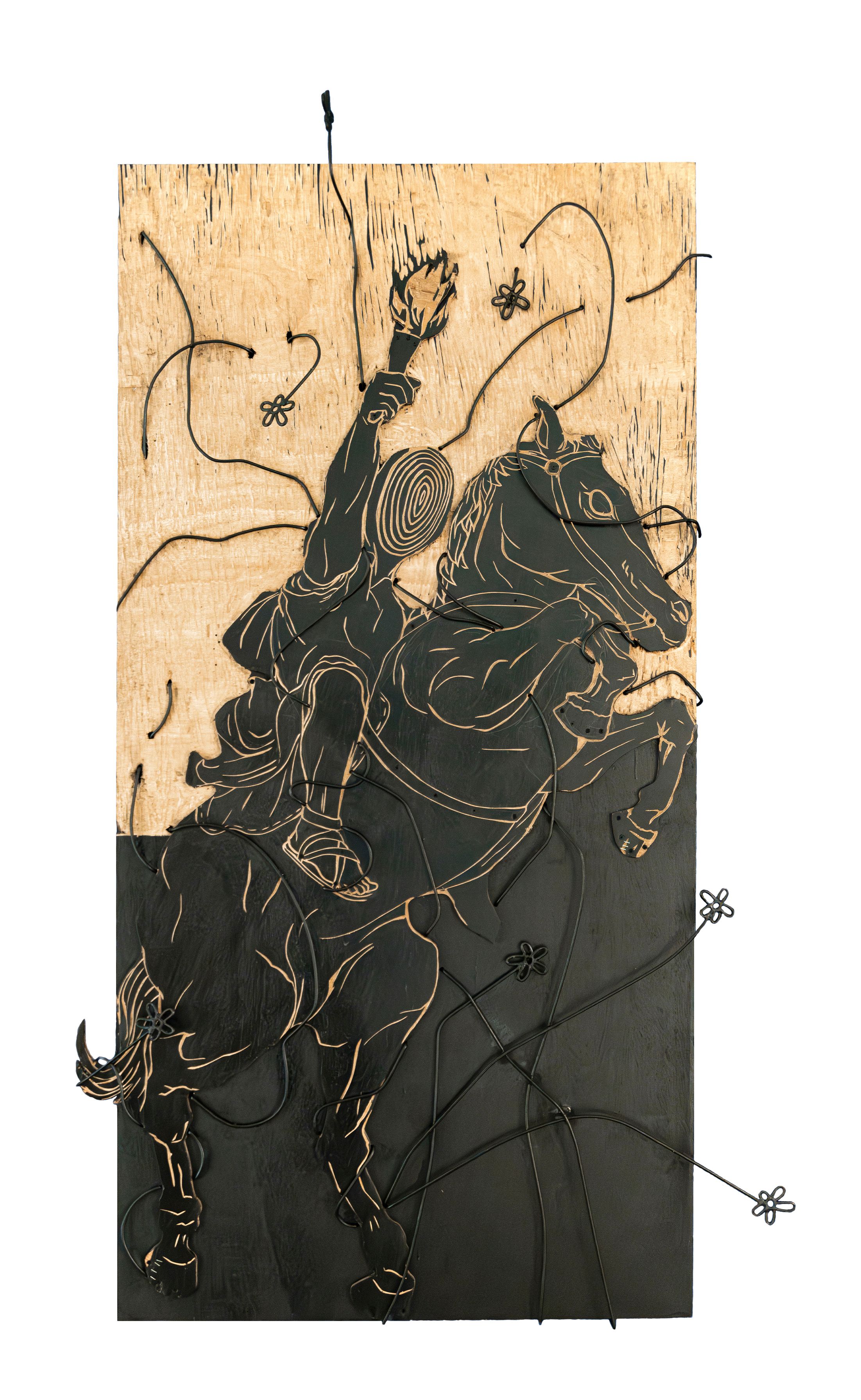
RA: Käthe Kollwitz seems to be a direct influence, and you have also cited artists such as Poussin, Rubens, and Gustave Doré. Why draw on European classical and academic imagery to tell African and personal histories?
AA: This approach comes partly from Paul Celan and the idea of a “counter-language.” Celan, who was Jewish and directly confronted with the violence of the Holocaust, continued to write in German, his mother tongue, but also the language of those who had participated in that violence. That contradiction had a profound impact on me: taking a language burdened by history and turning it around so that it can carry something else.
I have tried to transpose that idea into my own work, moving from counter-language to what I would call a counter-image. I take compositions, codes and sometimes images from European classical, academic or colonial painting and redirect them towards other histories. At first glance, a European viewer might recognize a familiar structure, a battle scene, a tragedy or a historical painting. But as they enter further into the work, they realize that the image is no longer telling the story of The Raft of the Medusa, a European battle or a heroic narrative. Instead, it becomes a vehicle for other realities: African histories, political or social violence, questions of territory, urban life and memory. The familiar image is turned against its own history and becomes a counter-image.
RA: Are there Ivorian or West African artists, past or present, who have shaped your visual language as much as these European references?
AA: Yes, absolutely. I think first of Christian Lattier, particularly for his relationship to sculpture, volume, and the construction of the body. Ibrahim Mahama is also an important reference for me, especially in the way he turns material into a vehicle for memory and history.
More broadly, beyond West Africa, I also look closely at the work of Wangechi Mutu, for her hybrid figures, almost mutant bodies, and the way she brings together mythology, history, and imagination; but also William Kentridge and Julie Mehretu. What connects me to these artists is not necessarily a shared aesthetic, but their ability to use material, the body, and the image to bring historical, political, and memorial narratives to the surface.
RA: How would you describe the art scene in Bonoua today and, more broadly, in Côte d’Ivoire?
AA: I would describe it as a very rich scene, with a great number of promising young artists. The talent is definitely there, sometimes in abundance, but the real question is one of support: institutional, cultural, and professional support, but also support that can be sustained over time. Today, we are beginning to see certain structures play a greater role and support artists in more concrete ways. So I think the challenge is not so much to discover talent as to create the conditions around those artists that allow them to develop, endure and build genuine careers. What will be particularly interesting is to see what this support produces five or ten years from now.
RA: What has changed in Abidjan’s art sector since you first began showing your work there?
AA: I think this transformation began long before me, more than fifteen years ago, and it is still taking place. We are seeing new exhibition spaces, galleries, residencies, independent initiatives, and spaces that are trying to provide greater support for artists. What is interesting is that we are still in the middle of this evolution, so perhaps it is too early to fully measure its effects. In a few years, we will probably be able to look back with greater perspective and understand what has really become established, what has endured, and how all of this has transformed Abidjan’s art scene.
RA: Are there emerging artists from Bonoua or elsewhere in Côte d’Ivoire who you think the wider art ecosystem should be paying more attention to?
AA: Yes, there are several. I am thinking in particular of Soro Kafana, the Tchinezan twins, Carl Édouard Keïta, and Ange-Frédéric Koffi. I find their practices very promising, with already distinctive universes and a real ability to develop their own visual languages. It will be interesting to see how their work evolves over the coming years, both within Côte d’Ivoire and beyond.
RA: Beyond Côte d’Ivoire, are there emerging West African artists you personally follow or believe deserve greater visibility?
AA: Yes. I am thinking in particular of the Senegalese artist Baye Ndiaga Diouf, the Ghanaian artist Emmanuel Aggrey Tieku, and the Togolese artist Thierry Tomety. I follow their work with great interest because each of them is developing a very personal universe and a distinctive way of approaching material, image, or narrative. I believe their practices deserve to be seen and supported on a much wider scale.
RA: What do you see as the biggest structural challenges facing the West African art scene today? And what would meaningfully change if those challenges were addressed, both for artists at your stage of career and for those just starting out?
AA: I think one of the main problems lies in the way cultural policies are conceived and implemented, both at local and national levels. Institutional support remains very uneven; some artists receive far greater visibility and support than others, and certain forms of art are also much more strongly promoted. This creates a form of elitism and deepens the gaps not only between different practices but also between artists themselves.
The paradox is that many artists eventually have to look elsewhere for the conditions they need to develop their work: in other African countries, in Europe, in the United States, or in Asia. Even when cultural policies do exist, they do not always benefit the artists who actually live and work locally. I find that unfortunate, because the continent is full of talent. The priority should be to strengthen local structures, support artists working on the ground, and allow them to build sustainable careers without leaving their own country or continent becoming almost a necessity.